This guide is for contractors, landscapers and site supervisors who must hire a compaction machine for backfill, a trench, a paving base or a road layer. Too small a machine leaves soft ground. Too big a machine is slow, costly or unsafe in a tight space. Here is how to settle plate compactor vs roller vs rammer.
Why does ground need compacting, and does soil type matter?
Compaction packs soil or aggregate tighter, so slabs, pavers, pipes and road layers settle less later.
A compactor does this with weight, vibration or impact, or a mix of them. It works best on thin layers: place one layer, compact it, then place the next. A thick layer may look flat on top and still be loose underneath.
What kind of ground is it: sand and gravel, or clay and silt?
Soil type is the first question, because it decides how the machine must work.
- Granular soil (sand, gravel, crushed stone) has loose grains. Vibration shakes the grains into a tighter arrangement.
- Cohesive soil (clay, and silty soil that behaves like clay) sticks together. Vibration alone does little. It needs impact or kneading pressure.
If you are not sure, ask the engineer or check the soil report. Do not guess from the surface: soil can change between the two ends of a trench.
Tip. Tell the supplier the soil type when you ask for a quote. It most often changes which machine is right.
Plate compactor vs roller vs rammer: which one for my job?
Use this table as a starting point. The project specification always has the final word.
| Your ground and work | Usual choice | Why | Watch out for |
|---|---|---|---|
| Sand or gravel, pavers, bedding layers, open area too small for a roller | Vibrating plate compactor | Flat plate vibrates grains together over a wide footprint | Weak on clay; light plates suit only thin layers |
| Trench, narrow space, around pipes and footings | Rammer (jumping jack) | Strong impact on a small foot fits where a plate cannot | Slow over large areas; operator fatigue |
| Clay or other cohesive soil in a small area | Rammer | Impact works where a plate compactor is less effective | Soil moisture; layer thickness |
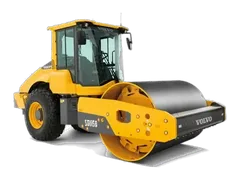
| Large area or road layer, granular material or asphalt | Smooth-drum vibratory roller | Weight and vibration cover ground quickly | Needs room to turn; not for tight trenches |
| Large area of cohesive soil | Padfoot roller | Studded drum kneads the clay | Surface must be finished or smoothed afterwards |
| Finishing certain layers where the specification asks for kneading | Pneumatic-tyre roller | Rubber tyres knead and seal the surface | Not a general-purpose choice; follow the specification |
When is a plate compactor the right choice?
A vibrating plate compactor suits granular soils such as sand and gravel. It is the usual choice for pavers, bedding layers and open areas that are too small to bring in a roller, such as a driveway, a yard or a patio base.
It is also the easiest machine to move around a small site. A forward-only plate is lighter and suits thin layers such as paver bedding. A reversible plate can travel forward and back, which helps in corners and at trench ends, and is usually heavier. Ask the supplier which type fits your layer. For a house plot, the equipment list for building a villa shows where compaction fits.
Do not use a plate compactor as a shortcut on clay. You may get a firm-looking crust over soft ground.
See the available plate compactors to compare types.
When is a rammer the right choice: trenches and clay?
A rammer, often called a jumping jack, delivers a strong impact through a small foot. That foot fits in a narrow trench and next to walls, pipes and footings, where nothing else can reach.
The impact is also why a rammer suits cohesive soil such as clay, where a plate compactor is less effective. Backfilling a service trench in layers is the classic use.
The limit is area. A rammer is slow on an open site and tiring for the operator. For a large area, move to a roller.
Browse rammers if your work is in trenches or tight spaces.
When do you need a roller, and which type: smooth drum, padfoot or pneumatic?
A roller suits large areas and road layers: it covers ground quickly and evenly. Three types matter most.
- Smooth-drum vibratory roller. For granular materials and asphalt. This is the usual roller for base layers and asphalt surfacing.
- Padfoot roller. The drum has raised pads that knead cohesive soil such as clay.
- Pneumatic-tyre roller. Rubber tyres knead and finish certain layers. Use it only where the specification calls for it.
A roller needs space to travel and turn, and a clear route onto the site. Small walk-behind rollers work on footpaths and narrow strips, while larger ride-on rollers suit open areas. Check access before you hire. For where rollers fit among the other machines on a road job, see road construction equipment in the order it is used.
Compare road rollers by type and drum.
How thick a layer can the machine handle, and how do you know it is done?
The layer thickness a machine can compact depends on its weight and force. Heavier machines handle thicker layers. The specification or the supplier's data states the limit, so ask for it in writing. Do not copy it from another job.
Moisture matters just as much. Soil that is too dry or too wet will not compact well. Add water, or let the soil dry, until it is near the moisture the specification calls for. In hot, dry weather soil can lose moisture between spreading and compacting, so plan a water supply, such as a water tanker, close to the work.
Passes alone do not prove the job is done. Compaction is verified by field density testing against the specification. Ask the engineer or the client who will test, and when.
What mistakes lead to rework or settlement?
- Layers too thick. The top looks tight and the bottom stays loose. Fix: place thinner layers and compact each one.
- Wrong machine for the soil. A plate on clay, or a smooth drum on soft cohesive soil. Fix: choose by soil first, then by area.
- Wrong moisture. Dust-dry or soggy soil. Fix: adjust moisture before compacting.
- Counting passes instead of testing. Fix: agree the test method with the engineer first.
- Ignoring what is buried. Compaction near buried services, walls or retaining structures may need a lighter machine, a non-vibrating mode or another method. Fix: check drawings and mark services before you start, and let the engineer decide the method.
Watch out. Vibration can damage pipes, cables, walls and retaining structures. Check what is buried or nearby before any vibrating machine starts work. Trench sides and roller edges can also collapse: follow the site's trench support and edge rules, and use trained operators with the protective equipment the site requires.
What should you ask the supplier before you hire?
- Is this machine suitable for my soil type and my layer thickness?
- What is its maximum layer thickness, and where is that stated (data sheet or manual)?
- Does it come with an operator, or do my people run it?
- When was it last serviced, and what is its condition?
- Is there a lighter machine, or one that can run without vibration, for work near walls or services?
- Is the operator trained on this machine, and who supplies the safety equipment?
For small tools used on the same jobs, see site power tools: which tool does which job.
How to do this on Maedah
Post one request with the machine, the quantity, your city and site on the map, and the dates. In the notes, write the soil type, the work area, the layer thickness and the moisture or testing requirement.
Suppliers who offer that category and serve your city send sealed quotes. They appear side by side, with what is included, response time and rating. Compare what each quote covers, then chat about the layer limit and the condition. Agree price and payment with the supplier.