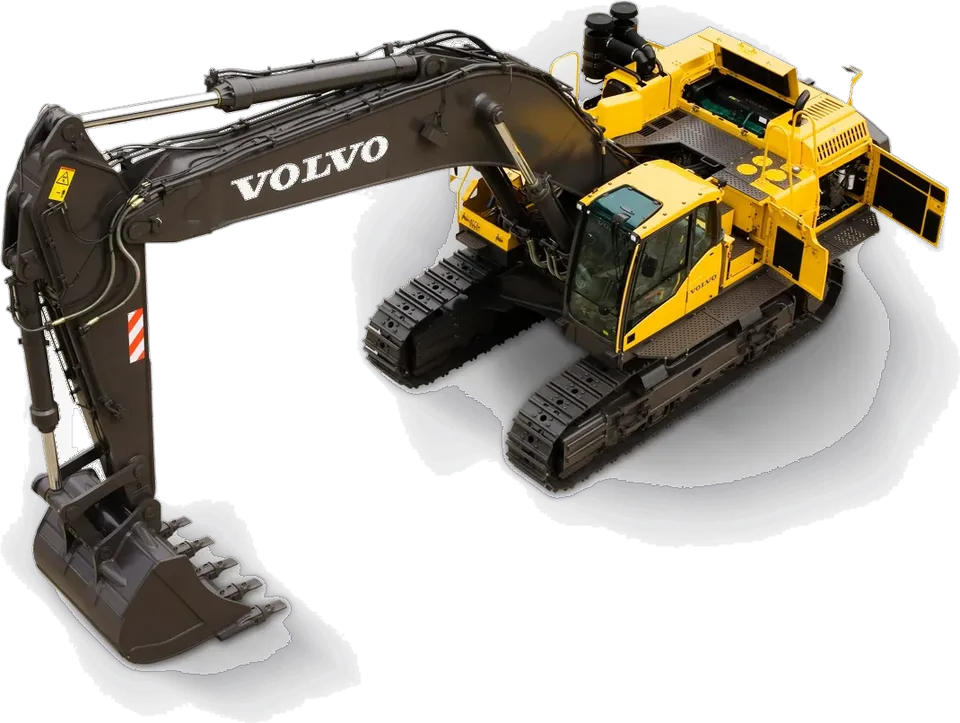
You need a machine on site, and you can pay cash, finance it or rent it. This guide is for small and mid-size contractors who must choose before they sign anything. It lists the questions to ask for each route and shows how to put all three on one comparison.
Cash, finance or rent: who owns the machine at the end?
Each route answers three questions differently. How much money leaves your business at the start? Who owns the machine when the period ends? Who pays when it breaks, sits idle or loses value?
| Route | Capital up front | Owner at the end | Repair, idle and resale risk |
|---|---|---|---|
| Cash | Highest: the full purchase | You | You |
| Finance | Lower: often a down payment, then instalments | Depends on the structure and contract | Depends on the contract; often you |
| Rent | Lowest: the first rental period | The supplier | Mostly the supplier, as agreed in the contract |
The table shows tendencies. The real answer is in the contract you sign, so read it before you decide.
Paying cash: what does it tie up, and what do you gain?
Paying cash is the simplest route. You own the machine, there is no financier to answer to, and you can sell it when you choose. You also avoid any extra amount a financier adds to the price.
The cost is what the money could have done instead. Cash in a machine is not available for payroll, materials, fuel or the next project. A contractor who waits for client payments can feel that quickly.
Ask yourself:
- If a client pays late for a few months, can the business still run after this purchase?
- Do I have a reserve for repairs, insurance and transport, not only for the purchase?
- Is the machine one I will use many hours every month, or one that will wait in the yard?
Watch out. Ownership brings costs that do not appear on the invoice: insurance, servicing, parts, storage, an operator and idle months. See what drives heavy equipment operating costs.
Financing: what questions should you ask the financier?
In Saudi Arabia, financing for equipment is often offered in Sharia-compliant forms. Two common structures are:
- Murabaha: the financier buys the asset and sells it to you at a disclosed higher price, payable in instalments.
- Ijara: a lease in which the financier owns the asset and you pay rent, sometimes ending with transfer of ownership.
Ask the financier which structure it uses and get the terms in writing. Then ask these questions:
- What down payment is needed?
- How long is the contract?
- What happens on early settlement?
- What insurance is required, and who must be named on the policy?
- Who holds the ownership documents during the contract?
- What happens on late payment?
- Can I sell, move or sub-rent the machine before the contract ends?
- Who is responsible for maintenance and repairs under the contract?
- Do I own the machine at the end, and on what terms?
Do not assume what a lender will approve or require. It differs by financier, by your business and by the machine, so ask each one directly. Maintenance in particular differs between structures and contracts, so do not assume it works as it does in a rental.
A financed machine usually cannot be sold freely until the financier agrees. This matters if you may want to sell before the end, for example because the work has stopped.
Tip. Ask for the full amount you will pay over the whole contract, in one number, including fees. Then you can compare it with cash and rent.
Renting: when is it the better answer?
Renting is often the better fit in three cases: the work is short, the work is uncertain, or the work is seasonal. It also lets you test a machine type before you commit to buying one.
With a rental, the supplier carries ownership costs and usually the maintenance. If the machine breaks, ask what the contract says about replacement. If the work ends, you return the machine and the cost stops.
Rent is not always the cheaper option. Over a long period of steady use, repeated rental periods can add up to more than ownership would. The deeper utilisation logic is in rent vs buy heavy equipment, and the practical steps are in how to rent heavy equipment in Saudi Arabia.
A common approach is a hybrid. You own the machines that work most hours every month, and rent specialist or peak-demand machines when a job needs them.
How do I compare cash, finance and rent on total cost?
A low monthly instalment can hide a high total. A rental rate looks large per day but stops when the job stops. Only the total over the same period gives a fair comparison.
Pick one period, such as the length of the contract or the length of your confirmed work. For each route, add up every cost in that period, then subtract what you keep at the end. In short: total cost = everything you pay in the period, minus what the machine is worth at the end.
| Cost line | Cash | Finance | Rent |
|---|---|---|---|
| Purchase or down payment | Yes | Down payment | No |
| Instalments and fees | No | Yes | No |
| Rental payments | No | No | Yes |
| Insurance | You | As the contract requires | Check who pays |
| Maintenance and repairs | You | Check the contract | Usually the supplier |
| Transport and operator | You | You | Check the quote |
| Idle months | You carry them | You carry them | Stop when you return it |
| Value at the end | Subtract it | Subtract it if you own it | None |
| VAT and other charges | Check | Check | Check |
Ask your accountant how VAT and other charges apply to each route. For example, say you compare a three-year period. Add everything you pay in those three years, then subtract what the machine could sell for at the end. Do the same for the rental of the same machine for the months you really expect to use it. Use honest estimates, and test a worse case in which the machine sits idle for part of the period.
The remaining value is the least certain line. Use a cautious figure and test the comparison again with it at zero. Ask suppliers or dealers how similar machines hold their value. If age affects your choice, see new or used equipment: how to decide. If you will buy used, follow buying used heavy equipment step by step.
What happens to the machine and the contract if the work stops?
Ask this before you sign, not after the work ends. The exit is part of the price.
- Cash: you can sell the machine, but you carry the market risk. A sale may take time, so do not plan around a quick one.
- Finance: the instalments continue. Ask about early settlement, and whether the financier must agree to a sale.
- Rent: read the minimum period, the notice needed to return the machine, and any return condition or charge.
Note. Requirements and contract terms differ by supplier, financier, project and insurer. Confirm each point in writing before you commit.
A common mistake is to choose the route that gives the smallest monthly payment and then find that the contract cannot be ended cheaply. The fix is to ask for the exit terms first.
How to do this on Maedah
Maedah lists machines for sale and for rent in one place, so you can look at the buy and rent routes together. For lifting machines, start with lifting equipment. For earthmoving, see excavation equipment.
To test the rental route, post a request with the machine, quantity, city, site, dates and any requirements such as driver or insurance. Suppliers send sealed quotes that line up side by side. Compare what each includes, then agree price and payment directly with the supplier you choose. Maedah does not process payments.