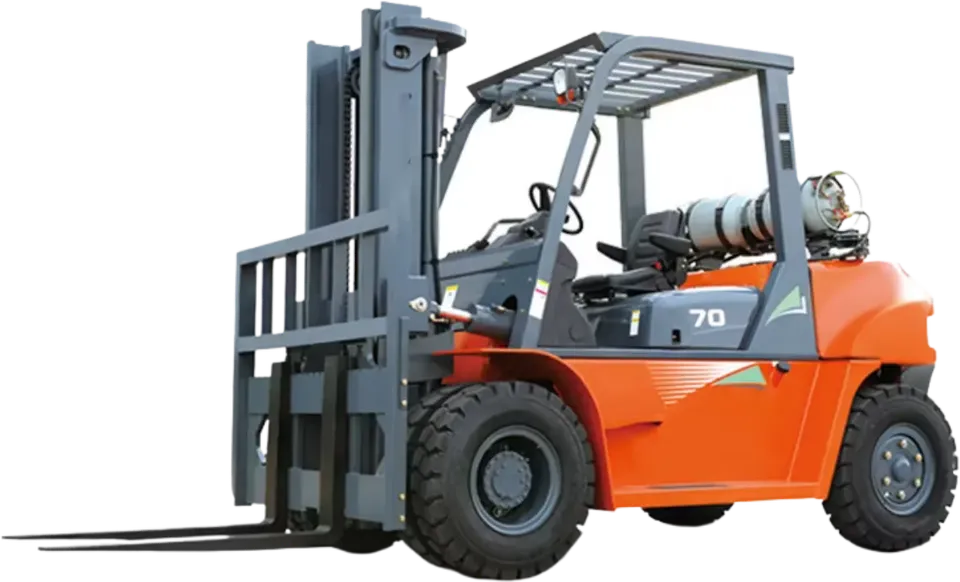
Read this if a listing says "3 tonne" and your load is long, tall or awkward, such as crates, pipe bundles or machinery on pallets. It has the forklift load centre explained in plain steps, a worked example and the exact questions to send the supplier before you hire.
What does the capacity on a forklift really mean?
The capacity on a listing is the rated capacity. It is the heaviest load the truck can lift at a stated load centre and up to a stated lift height. Both conditions matter.
A heavy bag is easy to carry close to your body and hard at arm's length. A forklift works the same way: the farther the load sits from the mast, the more it tries to tip the truck forward. So "3 tonnes" does not mean "any 3-tonne load".
What is a forklift load centre and how do you find it for your load?
The load centre is the horizontal distance from the vertical face of the forks (the fork shank) to the centre of gravity of the load. A load centre of 500 mm is commonly used as the standard rating, but the truck's own plate states the figure that applies.
To find yours, use the load's depth along the forks:
- Push the load fully back against the fork shank, as it must be carried.
- Measure the depth of the load along the forks, in millimetres.
- For an even, uniform block, the centre of gravity is half of that depth.
- If the weight is not even, the centre is closer to the heavy part. Get the real centre of gravity from whoever packed or made the load.
Note. Load centre is measured from the fork face, not from the tip of the forks.
What lowers forklift capacity: long loads, high lifts, attachments?
If your load's centre of gravity is farther out than the rated load centre, the truck can safely lift less than its headline capacity. The data plate or the manufacturer's capacity chart gives the reduced figure; nobody should guess it by eye. These conditions can lower capacity:
| Condition | What changes | What to do |
|---|---|---|
| Longer or deeper load | Centre of gravity moves out past the rated load centre. | Ask for the reduced figure at your load centre. |
| Tall or uneven load | A high or off-centre centre of gravity makes the load less stable. | Tell the supplier the load's height and how it is packed. |
| Higher lift | On many trucks, capacity falls as the forks go higher. | Give the supplier your maximum fork height. |
| Side-shifter, fork positioner, clamp or other attachment | The attachment adds weight and moves the load forward. | Ask for the plate figure for the truck as fitted. |
How do you read a forklift data plate before the first lift?
The data plate is a metal plate on the truck. Read it before the first lift, and again whenever an attachment changes.
- Rated capacity at the stated load centre.
- Load centre in millimetres.
- Lift height the capacity applies to.
- Any extra lines or a chart for attachments or for different heights.
The plate must be legible and match the truck in front of you. If it is missing, painted over or unreadable, do not use the truck. Do not accept a verbal figure, or a photo of a different truck's plate. Ask the supplier to fit a new plate or send another truck first.
Check the forks too. Bent, cracked or worn forks make the lift unsafe, and so do forks too short to support the load. As a common guide, forks should reach under roughly two thirds or more of the load's depth; follow the manufacturer's advice. For a daily routine, see the forklift pre-start checklist.
Why does a forklift tip over? The stability triangle in plain words
A typical counterbalance forklift (the usual type, with the weight at the back balancing the load at the front) rests on three points: the two front wheel contact points and the pivot point of the rear axle. Draw lines between them and you get the stability triangle.
The truck is stable while the combined centre of gravity of truck and load stays inside that triangle. An overload, a long load, a high lift, speed, a sharp turn or soft, sloping ground can push it outside, and these factors add up. Only trained, authorised operators should drive the truck, slowly, with the load low and tilted back as the manufacturer advises.
What should you ask the supplier before you hire a forklift?
For example, say a listing shows a 3-tonne truck rated at a 500 mm load centre. Your crates are 1,400 mm deep along the forks, so the centre is half of that, 700 mm. That is 200 mm farther out than the rating.
The truck will lift less than 3 tonnes with that load. By how much depends on the plate or chart for that exact truck, and neither you nor the operator should guess it. By the two-thirds guide, forks should be about 930 mm or more.
So the question to the supplier is: "What is the rated capacity of this truck, as fitted, at a 700 mm load centre and a lift height of (your maximum height)?"
Compare the figure the supplier gives with your load's real weight. If it is lower, or the plate or chart does not cover a 700 mm load centre, this truck is not suitable. Ask for a higher-capacity truck, or change the load: shorter pieces, heavy end at the fork heel. For very long loads, consider whether another machine suits the job; see forklift types and how to choose.
Also tell the supplier your load's weight, depth along the forks, height and the highest point you must lift to. Then ask, in writing:
- What fork length is fitted, and is it right for a load this deep?
- Is the capacity reduced at my maximum fork height?
- Can you send photos of the data plate and the forks before delivery?
For truck choice and mast height, see how to hire a forklift.
Do not hang or sling a load from the forks unless the truck has a suitable attachment and the manufacturer approves it. Suspended loads are a rigging task; see rigging basics and working load limits.
How to do this on Maedah
Browse the forklifts category for photos and specs, then post a request once instead of calling around.
- Write your load's weight, depth along the forks and highest lift, plus any attachment, an operator if needed, and the city and site.
- Compare what each quote includes, and use chat to ask for the data plate figures.
Maedah does not process payments or inspect machines. You agree the terms with the supplier, so get the capacity confirmed before you accept.