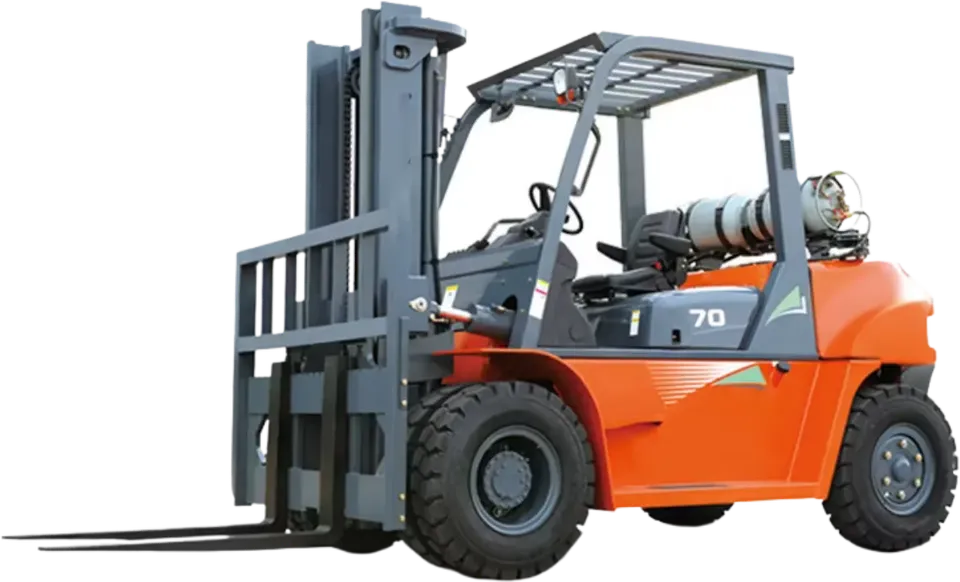
This guide is for anyone who has to hire a forklift this week: a warehouse supervisor, a site manager, a procurement officer. A truck that is too weak, too tall or too wide wastes a day. Take a tape measure to the site and weigh the heaviest pallet. Then write eight lines into your request, so each supplier can offer a truck that fits.
What do you measure before you ask for a forklift?
Do not start with "I need a 3-tonne forklift". Fill in this worksheet, then copy each line into your request.
| Measure | How to take it | Example wording for the request |
|---|---|---|
| Heaviest load | Weigh the heaviest single pallet or item, with packaging | "Heaviest load 1,800 kg, single pallet" |
| Load size and centre | Length, width and height; the centre of weight | "Pallet 1.2 m x 1.0 m x 1.4 m, weight centred" |
| Lift height | Height of the highest rack beam or truck bed, plus clearance | "Forks must reach 5.5 m with this load" |
| Lowest doorway or roof | Measure the real opening, with lights and pipes; the truck's overhead guard counts too | "Lowest clearance 2.4 m at the gate" |
| Aisle or gateway width | Narrowest point the truck must turn or pass | "Aisle 3.2 m between racks" |
| Floor, ramps, dock | Surface, slope, soft areas, dock height | "Concrete slab inside, gravel yard outside" |
| Power type and place | Diesel, LPG or electric; indoor, outdoor or both | "Electric preferred, mostly indoors, some work in the yard" |
| Operator and period | Who drives, start date, how long | "With operator, 3 weeks from 1 November" |
How do you choose the capacity for your heaviest load?
Capacity is stated at a load centre, commonly 500 mm but as the data plate says: the distance from the fork face to the centre of the load's weight. A long or bulky load puts its weight further out, so the truck can lift less. On many trucks capacity also falls at greater lift heights and with attachments such as side-shift or long forks. The figure that counts is the one on the data plate for the truck's actual set-up. Our guide to forklift capacity and load centre explains how that works.
Choose for the heaviest single load, even if the other forty pallets are light. Select a truck whose capacity at your lift height comfortably exceeds it: for example, a truck sold as "2 tonne" may not be enough for an 1,800 kg pallet at a high beam. Never load a truck beyond the rated capacity on its data plate.
Tip. Write the need as one line: "1,800 kg at this pallet's load centre, lifted to 5.5 m, with side-shift fitted." Ask the supplier to confirm it from the data plate.
What lift height and mast height do you need, and what is free-lift?
- Maximum lift height: how high the forks can raise the load. Add clearance above the beam or bed, so the load does not catch.
- Lowered (collapsed) mast height: the height of the truck with the mast fully down. This decides whether it passes through a doorway, goes into a container or fits under a low roof. Also check the height of the overhead guard, which is sometimes the tallest part.
- Extended mast height: the height of the mast top with the forks fully raised. Check it against ceilings, sprinkler pipes and lights at the place where you will lift. Ask the supplier for it when your lift is under a roof.
- Free-lift: how far the forks can rise before the mast starts to extend upward. With good free-lift you can stack inside a container or under a low ceiling. With little free-lift, the mast hits the roof as soon as the forks rise.
The common mistake is giving only the lift height. A truck that reaches 6 m may be too tall to enter your gate. The mast type, for example two-stage or three-stage, changes the lowered height and the free-lift, so ask for it in the quote. Write the numbers in the request: "Lift height 5.5 m, lowered mast must be under 2.4 m, free-lift needed for container work."
How wide must the aisle or gateway be?
Do not use the truck's body width as the aisle width. The space a forklift needs depends on its type and on the load size, because the truck must turn with the load on the forks.
A counterbalance forklift needs the widest turning space. A reach truck works in narrower aisles. A narrow-aisle truck usually needs a very flat floor and often a guided aisle, so ask the supplier. A pallet stacker or jack has a small footprint for light loads. Forklift types and how to choose covers the rest.
Ask the supplier: "What is the working aisle width for this truck with a pallet of this size?" Say how the pallet will be carried, lengthwise or crosswise, because it changes the answer. Measure the clear width at the tightest point, between the closest obstructions on both sides, such as columns, rack uprights, parked pallets or a gate post. Do not measure wall to wall if something sticks out of the wall. If the job is mostly short lifts of light pallets, look at pallet stackers and jacks before you hire a full forklift.
Fork length matters too. The forks should support most of the load's depth. Short forks under a long load make it unstable; very long forks can reach into the next pallet. Longer forks or an attachment can also lower the truck's capacity, so put them in the request and ask for the capacity with them fitted.
What about the floor, ramps and loading dock?
Describe the floor in the request in plain words; it decides which truck can work safely.
- Surface: smooth slab, rough concrete, gravel, sand or soft ground. Sand and soft ground may need pneumatic tyres or a rough-terrain machine; ask the supplier.
- Slopes and ramps: say where, how steep they look and whether the truck will be loaded on them.
- Dock and levellers: state the dock height and whether a leveller is used.
- Ground clearance: a truck with low ground clearance can touch the ground at the top of a ramp or at a kerb. Ask the supplier for the truck's maximum safe gradient, and do not assume any truck suits a steep ramp.
Watch out. Never assume a yard is solid because it is dry on top. If part of the route is soft or filled ground, say so, and ask the supplier whether the chosen truck is suitable.
Operator, power type, hire period and delivery: what else to settle?
Operator. Dry hire supplies the machine only. Wet hire supplies the machine with an operator. Whichever you choose, the operator must be trained and authorised for that type of truck (see how to check an operator's competence), and the request should say who provides one. Requirements for operator certification differ by site owner, insurer and project, so confirm what the site accepts before mobilising. The wet hire vs dry hire guide sets out what each option covers.
Power type. Decide it with the diesel, LPG or electric forklift guide, and write your choice in the request.
Hire period and delivery. Give a start date, an expected length, the unloading point and who to call on site. Ask how a breakdown or replacement truck is handled, and who covers fuel or charging. An electric truck needs a suitable charger and power point.
Condition and paperwork. Ask for the truck's current inspection certificate and its expiry date, and check the truck on arrival before it starts work, using the forklift daily pre-start checklist. Do not accept a truck with a missing data plate or a defect.
How to do this on Maedah
Open a forklift request, choose Forklifts (or Pallet Stackers & Jacks for light work) and state the truck type you need, for example counterbalance or reach truck, in the request text. Put your worksheet lines there too. Add the city, the site on the map, the dates and whether you want a driver.
Suppliers who offer forklifts in that city can send sealed quotes. Because every quote answers the same measurements, you can put them side by side and compare like with like. Agree price and payment with the supplier.