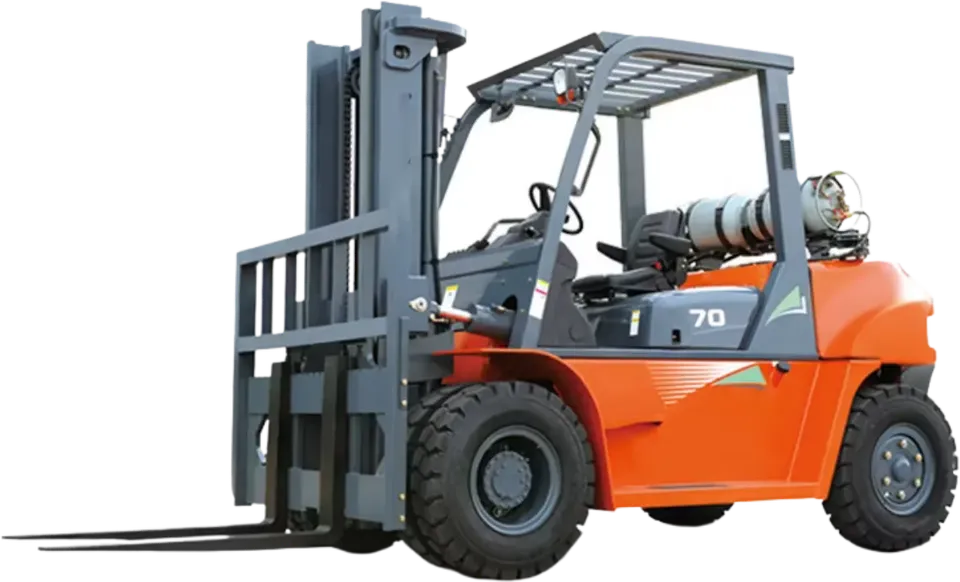
A supplier list can show forklift, reach truck, stacker, jack and telehandler for what looks like the same job. If you run a warehouse, a factory or a site, the names hide the real question. This guide sorts the main types of forklifts and handling trucks, so you can name the right machine when you ask for it.
What types of forklift and handling truck exist?
These seven types cover the machines this guide compares. The table puts them side by side.
| Type | Surface | Lift height | Typical task |
|---|---|---|---|
| Counterbalance forklift | Flat floor or yard | Medium to high | Loading and unloading trucks, moving pallets indoors and outdoors |
| Reach truck | Smooth indoor floor | High | Putting pallets into racking in narrow aisles |
| Pallet stacker | Smooth floor | Low to medium | Lifting a pallet to a shelf or low rack |
| Pallet jack | Smooth floor | Just off the floor | Moving a pallet a short distance |
| Rough-terrain forklift | Unpaved, uneven ground | Medium | Moving materials on a building site or open yard |
| Telehandler | Unpaved, uneven ground | High, with forward reach | Placing loads over a gap or onto a raised level |
| Reach stacker | Paved yard or port | Container stacking height | Moving and stacking shipping containers |
"Low", "medium" and "high" are only a guide. The real figure is on the data plate of the exact truck you hire or buy.
Other types exist for special jobs, such as side loaders for long loads like pipes and bars. Ask the supplier if your load is long or an unusual shape.
Which truck suits a warehouse with racking, and which suits an open yard or site?
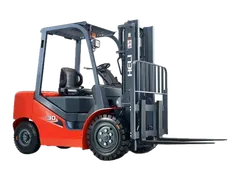
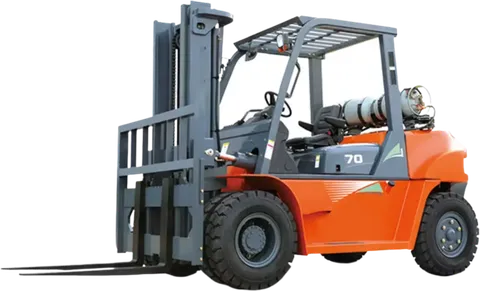
A counterbalance forklift carries the load on forks in front of the front axle. The weight of the truck itself, mostly a heavy counterweight at the back, balances the load. This makes it the general-purpose type for loading trucks and moving pallets.
Counterbalance trucks come with different tyres. Solid or cushion tyres suit smooth indoor floors. Pneumatic tyres suit outdoor yards, but only reasonably firm, level ground. Soft sand, deep ruts or slopes usually call for a rough-terrain forklift or a telehandler.
A reach truck is built for warehouse racking. The mast or the forks move forward to place the load, so the truck can work in narrower aisles than a counterbalance truck. It is normally meant for smooth indoor floors only.
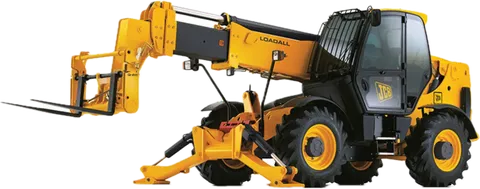
A rough-terrain forklift or a telehandler has large pneumatic tyres made for unpaved, uneven ground. The telehandler also has a boom that extends forward instead of a vertical mast. For the wider list of machines a build needs, see equipment for a warehouse build.
Watch out. Do not use an indoor truck on soft or broken ground. Small hard wheels can sink or catch, and a tipping load is dangerous for everyone nearby. Only an operator trained and authorised by the employer and accepted by the site owner should drive any truck (how to check competence). Never lift people on forks or a pallet. The only exception is a purpose-made work platform approved for that machine, used under the manufacturer's and site's rules.
For the narrower question of capacity, mast height and aisle width on a hire, read how to hire a forklift.
When is a pallet jack or pallet stacker enough?
A pallet jack lifts a pallet just off the floor and moves it. It does not stack. A pallet stacker also lifts the pallet to a shelf or low rack. Either can be hand-operated or powered.
Both typically have lower capacities and lift heights than a forklift. They suit:
- short moves inside a store, shop or small workshop
- light pallets on a smooth, flat floor
- low shelving, where a full forklift would be too big for the space
If you stack above shelf height, move heavy loads, or cross rough ground, move up to a forklift. Browse pallet stackers and jacks to see what is listed.
When do you need a reach stacker or a telehandler instead of a forklift?
A reach stacker is a heavy container-handling machine for yards and ports. It is chosen by container weight and stacking height. It is not a substitute for a warehouse forklift, and a warehouse forklift cannot do its job. See the reach stackers listed on Maedah.
A telehandler is the answer when the load must go forward and up. Think of a pallet that has to land on a raised level or beyond a trench, where a vertical mast cannot reach. The guide telehandler or forklift compares the two in more detail.
A telehandler and a reach stacker are rated by a load chart, not one number. What they can carry drops as the boom extends or rises, so check the chart for your load at your reach and height.
Three questions that choose the type: what, where, how high?
Answer these in order. Cross out every type that an answer rules out.
- What are you moving? A pallet, a loose load, or a container? Write down the heaviest single load, and its size.
- Where does it move? Smooth indoor floor, a paved yard, or unpaved ground? Note any narrow aisles, ramps or doors. The lowered mast must pass under every door frame.
- How high does it go? Floor level, a shelf, a high rack, or a raised work level? Measure from the floor to the top of the highest place a load must reach.
Now read the answers together:
| Your answers | Likely type |
|---|---|
| Pallets, high racking, narrow aisles, smooth floor | Reach truck |
| Pallets, trucks to unload, indoors and outdoors, level ground | Counterbalance forklift |
| Light pallets, short moves, floor or low shelf | Pallet jack or pallet stacker |
| Materials, unpaved ground, medium height | Rough-terrain forklift |
| Materials, unpaved ground, forward reach to a raised level | Telehandler |
| Shipping containers in a yard or port | Reach stacker |
High racking with wide aisles can also be served by a counterbalance forklift with a tall enough mast. Choose the reach truck when aisle width is the limit.
Note. Check the machine's capacity at the right load centre before you decide. Forklift capacity and load centre explains how to read it.
Fuel is a separate choice, made after the type. See diesel, LPG or electric for that.
What do the names mean in Arabic, English and on supplier listings?
Listings mix languages, so the same machine can appear under several names. On Arabic listings a forklift is written as فوركلفت or رافعة شوكية. Pallet stackers and jacks sit under ستاكر وجاك طبالي, and a reach stacker is ريتش ستاكر. A telehandler is often written in Arabic letters as تيلي هاندلر.
Use this as a guide when you read a listing in any language:
- "Forklift" alone usually means a counterbalance forklift. Check the photo to be sure.
- "Stacker" alone is ambiguous. It may be a small pallet stacker or a heavy container reach stacker. Check the capacity and the photo.
- "Jack" or "hand pallet truck" means a pallet jack.
- "Telehandler" or "telescopic handler" means the boom type.
- "Reach stacker" is the container machine, not a reach truck.
If a listing is unclear, look at the tyres and the mast. Then ask the supplier which of the types above it is, and which tyres it has.
How to do this on Maedah
Maedah lists forklifts, reach stackers and pallet stackers and jacks as separate categories. In the request, write the exact type you need, for example "reach truck" or "rough-terrain forklift", so suppliers quote the right machine.
In your request, choose the machine and quantity, then describe the heaviest load, the lift height and the surface in the notes so suppliers can quote the right truck. Add your city and site on the map, the dates, and any requirement such as a driver.
Suppliers send sealed quotes. They line up side by side. Compare what each includes, then agree price and payment with the supplier you choose.