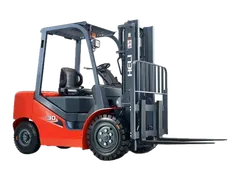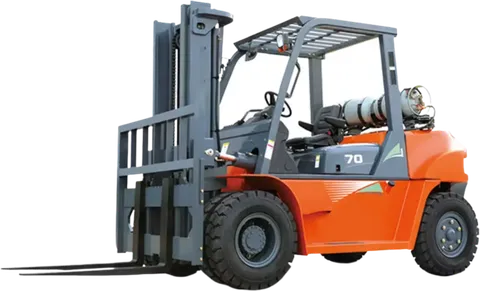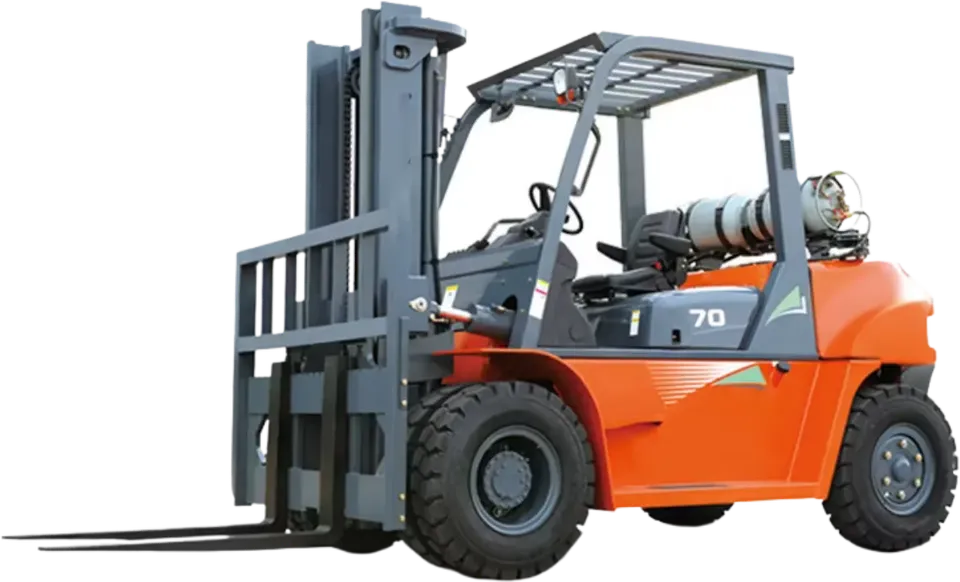
You may be the operator, the supervisor who signs the sheet or the hirer of a rented truck. This forklift pre-start checklist shows what each failed check looks like and when the truck must stop work. It ends with ten operating rules.
Why check a forklift before every shift?
A fault can appear between shifts: a hose leaks, a fork cracks, a tyre is damaged. Check before the first use of each shift, and again if the truck changes hands, because a different driver may not know what has happened since the last check.
The check takes a few minutes. Write down the date, the truck number and any defect. Requirements differ by project, site owner, municipality and insurer, so confirm what applies before you start work.
What do you check on the walk-around: tyres, forks, mast, chains, leaks?
Start outside, engine off, truck on level ground.
| Item | What a defect looks like | What to do |
|---|---|---|
| Tyres and wheel nuts | Cuts, missing chunks, flat tyres, low pressure, loose nuts, objects in the tread | Flat tyre, deep cut, missing chunk or loose wheel nut: do not drive, tag out. Low pressure on pneumatic tyres: report (check the manufacturer's figure; heat raises pressure). Object in the tread: report. |
| Forks | Cracks (heel, the corner where blade meets shank, and welds), bends, worn heel, forks uneven in height or different in wear | Tag out. Never straighten or weld forks on site. |
| Fork locking pins | Missing, bent or not engaged | Fit or replace before use. |
| Mast and carriage | Cracks, bent rails, loose bolts | Tag out if damaged. |
| Lift chains | Broken or cracked links, rust, dry chains, one chain longer than the other | Broken or cracked link, or one chain clearly longer than the other: tag out. Rust or dry chain: report so it is lubricated or replaced. |
| Hydraulic hoses and cylinders | Cuts, bulges, rubbing, wet patches | Cut, bulge, or any wetness or drip of hydraulic fluid: tag out. Light rubbing marks with no wetness: report. |
| Hydraulic oil level | Below the minimum mark on the tank or dipstick | Report it. Do not top up with unknown oil; ask the supplier which to use. |
| Floor under the truck | Fresh drops or puddles of oil, fuel, coolant or hydraulic fluid | Fresh wet or pooling fluid of any kind (hydraulic, fuel, engine oil, coolant): tag out. Dry, dusty stain with no fresh fluid: report. |
| Overhead guard and load backrest | Cracks, bends, missing bolts, removed parts | Tag out. The truck is not safe without them. |
Judge tyre and fork wear against the manufacturer's limits, not by eye. Ask the supplier if you do not know them.
What do you check on the power source: fuel, engine, gas cylinder or battery?
Diesel or petrol engine trucks
- Engine oil and coolant at the right level, with no leaks around the engine. Check coolant only when the engine is cool; never open a hot radiator cap.
- Enough fuel for the shift, and no fuel smell or wet patches.
- A radiator not blocked with dust, which matters on hot, dusty sites.
LPG trucks
- The engine checks above also apply.
- The gas cylinder is held securely in its bracket, and the fitting and hose are undamaged.
- If you smell gas, do not start the truck and keep ignition sources away. Only trained people change cylinders.
Electric trucks
- Battery case and cables are undamaged, the connector fully pushed in, and the charge enough for the shift.
- Only trained people top up battery fluid or charge the battery.
What do you check from the seat: brakes, steering, horn, lights, seat belt?
Climb on using the steps and handholds.
- Seat belt. It must be present, clean and working. Fasten it every time you drive.
- Instruments. Warning lights should go out after start-up, except those that show a state such as the parking brake applied. A fault light that stays on: report it, and do not work until someone competent has checked an oil-pressure or overheating warning.
- Parking brake. Apply it and follow the manufacturer's test. If the manual gives none: seat belt fastened, area clear, truck empty, select drive and apply gentle power against the applied brake. If the truck moves, tag out.
- Service brake. Test it at slow speed in a clear area. A long pedal, a soft pedal or a pull to one side is a defect.
- Steering. It should feel smooth, with no free play or stiff spots.
- Horn, lights, beacon and reversing alarm. All that are fitted should work, and the horn must be heard over site noise.
- Data plate. It must be fixed and readable, because it shows the rated capacity and the load centre it applies to. Without it, do not use the truck.
- Visibility. Mirrors, windscreen and camera, where fitted, are clean and not cracked, so you can see the travel path.
How do you test the lift, tilt and hydraulics before loading?
With the area clear of people and the truck empty, raise the forks to near the top and lower them. Then tilt the mast fully forward and back, slowly. Listen for grinding, squealing or knocking. Watch for jerky movement, forks that creep down when held, or slow response.
Slow or weak hydraulics can mean low oil, a leak or a worn part: report it.
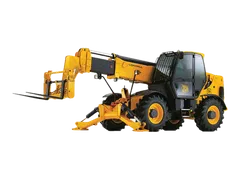
A telehandler has a boom instead of a mast. Use its manual for the boom, stabiliser and attachment checks, and its own load chart.
Tip. Take the first load only after the lift test passes. For its weight limit, see forklift capacity and load centre explained.
What do you do when you find a defect?
Use one rule: the truck stops work if the item is marked tag out in the walk-around table, is in the list below, or brakes or steering feel wrong. Also tag out for:
- a missing or faulty seat belt, horn, reversing alarm or beacon, where fitted;
- a missing or unreadable data plate;
- a damaged battery case or cable;
- any smell of gas or fuel.
Rust, a dry chain, light rubbing or a dirty mirror means report.
- Park safely with the forks lowered, switch off, apply the parking brake and remove the key.
- Attach a "Do not use" tag with the date and a short note of the defect.
- Report it to your supervisor and to the supplier or the company that maintains the truck.
- Keep the truck out of service until someone competent has repaired it and confirmed it is fixed.
Report minor items too; the supervisor decides if work continues. If unsure, treat it as a safety defect. Driving carefully does not make a truck with weak brakes safe. For a routine that covers any machine, read daily walk-around inspection and defect reporting.
What safe-operating rules apply once the truck is working?
These ten rules cover the basics. The site owner and employer set the full rules, including who may operate a truck; see how to check an operator's competence.
- On a sit-down truck, keep the belt fastened and arms and legs inside the frame. If it tips over, stay in the seat and hold on; do not jump out. For stand-on or reach trucks, follow the manual.
- Carry the load low and tilted back, with the forks just clear of the ground.
- Keep to the rated capacity on the data plate. Never add weight to the back of the truck.
- Never carry passengers or lift a person on the forks.
- Slow down for turns, ramps, wet floors and uneven ground.
- On a ramp with a load, keep the load uphill: forwards going up, in reverse going down. Do not turn on a slope.
- If the load blocks your view, travel in reverse or use a banksman.
- Sound the horn at blind corners, doorways and aisle crossings.
- Never reach through the mast, or let anyone stand under raised forks.
- Never leave the truck with the forks raised or the engine running.
Keep pedestrians out of the lifting and travel path and use a banksman at blind corners; banksman and exclusion zones explains how.
How to do this on Maedah
To hire a forklift, give the machine type, city, site and dates in your request, and say whether you need diesel, LPG or electric. Browse forklifts or telehandlers.
Compare what each quote includes, and ask in chat for the current inspection certificate, the service record and who to call for a fault. On delivery, use the handover and return checklist, then run this check before first use.