You have a ceiling, a mezzanine edge or an outdoor wall to reach, and a supplier who needs more than "one scissor lift, please". Answer five questions about the job, and each answer becomes one line of your request.
How to choose a scissor lift: start with the work height
Scissor lifts are usually listed by platform height, the height of the platform floor when fully raised. The point your people actually work at is higher. Working height is the platform height plus the reach of a person standing on it. A common planning habit is to add roughly two metres. Treat that as a first estimate. Work backwards: measure the highest point your people must touch, then subtract the reach allowance.
A common mistake is to order a machine whose listed height equals the height of the work. If that number is the platform height, the platform floor would reach the ceiling and the person would have no headroom. If it is the working height, the platform floor is roughly two metres lower. Always check which of the two figures the listing shows, and ask the supplier to name both.
Tip. Look up before you book. Pipes, ducts and cable trays hang below many ceilings. Measure the clear height under the lowest obstruction, and keep a safe gap so nobody can be trapped against the structure above.
A scissor lift goes straight up and does not reach out over obstacles. For a wall, also measure how far the machine must stand from it. A footing, kerb or planter at the base can keep the platform from reaching the surface, and you may need a different machine. If you are unsure of the type, read scissor lift or man lift: which one do you need first.
How many people and how much material go on the platform?
The rated platform load is the total weight of the workers, their tools and the materials. It is marked on the machine, together with how many people the platform may carry. Use the heaviest realistic load, not the average day.
- Add up people, tools, fixings and the heaviest single item.
- Ask the supplier for the rated load of the exact machine, not of the model family.
Also check the platform size against the longest or widest item, such as a duct section. If it will not fit, ask about an extension deck. An extension changes the stated limits, so ask the supplier to confirm the combination in writing.
Electric or diesel scissor lift: which power type?
The deciding question is where the machine will work. Indoors on a hard floor, or outdoors on rough ground?
| Option | Best for | Watch out for |
|---|---|---|
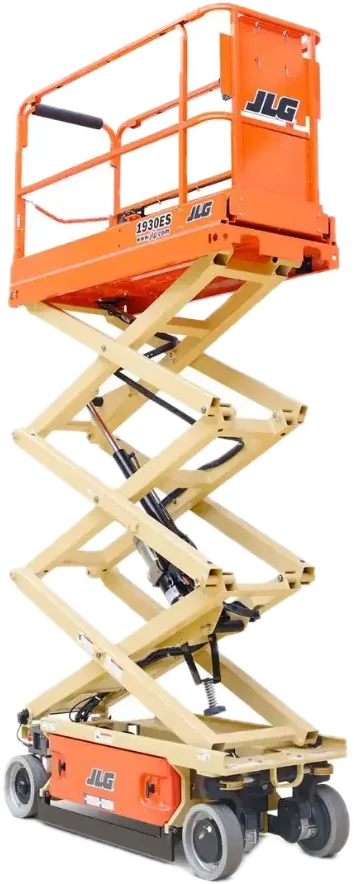
| Electric (battery) | Indoor work on firm, smooth floors: warehouses, malls, factories, finished buildings | Not built for rough or soft ground; needs charging between shifts |
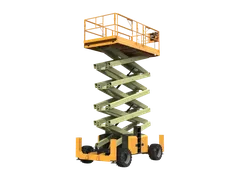
| Engine-driven rough-terrain | Outdoor work: building sites, yards, uneven ground | Heavier and larger; never run it in an enclosed space; check where exhaust goes near people |
Electric lifts are quiet and produce no exhaust, so they suit occupied buildings. Rough-terrain scissor lifts are usually engine-driven, though other power types exist. If the work is indoors but the machine must cross a rough yard first, ask which machine can do both, or plan two machines.
Is the floor or ground strong and level enough?
A scissor lift is heavy for its size, and the weight sits on a few small contact points.
Indoors, ask the building owner or facility manager:
- What is the slab's load limit, and does it cover a machine of this weight? Ask the supplier for the machine's wheel load as well as its total weight, because a slab limit may be stated per area or per point.
- Are there raised floors, basements, trenches or voids under the route or the work spot?
- Is the floor finished, and may wheels run on it?
Outdoors, the ground must be firm and reasonably level. The usual causes of an unstable machine are holes, soft backfill, drains, trench edges and slopes.
Watch out. Do not rely on a number from a website or from memory for slopes or wind. The manufacturer's manual states what that machine can do, and the supplier should be able to show it.
If the surface is doubtful, say so in the request. Operating checks and limits are in scissor and boom lift pre-use checks and operating limits.
Can the machine get to the work area?
A machine that fits the job can still fail to fit the route.
- Ask for the machine's width and height as it travels (with the guardrails folded, if they fold).
- Measure doorways, gates, corridors and turning space on the route.
- If a goods lift is involved, ask the building manager for its marked load and cabin size, and compare both with the machine's weight and folded size.
- Check ramps, raised slabs and thresholds on the way.
- Agree how the machine will be unloaded and who will drive it from the truck.
What about charging, fuel and outriggers during the job?
- Electric: decide who supplies the charging point, and ask what power supply the charger needs.
- Engine-driven: decide who supplies the fuel and where it is stored safely on site.
- Outriggers: if the machine uses them, they need clear space and firm ground under each foot. Ask how much space the machine needs when set up.
For a long summer job, ask the supplier whether the machine has been serviced recently and who attends if it stops, and agree charging or refuelling times that avoid the hottest hours. Requirements differ by project and site owner.
Also decide who operates the machine. Operator training and fall-protection rules differ by project, site owner, municipality and insurer, so confirm them before mobilising. See wet hire vs dry hire: with or without an operator.
Worked example: from job description to a request
This is an example, not a recommendation for any real site.
The job: fix lighting and ductwork under the steel roof of an indoor workshop. The roof steel is at 8 metres, and the lights and ducts will be fixed at about 7 metres. The floor is a smooth concrete slab. Two workers, tools and fittings go up together. The entrance is a roller door, then a short ramp.
Turning it into five lines:
- Work height: about 7 metres, the height of the highest fixing. Allowing roughly two metres of reach, look for a platform height of at least 5 metres. Machines come in fixed sizes, so in practice ask for the next size up, and check the gap below the roof steel for that taller platform.
- Platform load and size: say two workers at 90 kg each, 40 kg of tools and fittings, so 220 kg. Ask for a rated load above that, confirmed on the exact machine. If the longest duct is about 3 metres, check the platform length.
- Floor or ground: indoor concrete slab. Ask the facility manager for the slab's limit.
- Power type: electric, because it is indoors on a hard floor. A charging point is available near the door.
- Access route: roller door, short ramp, then straight to the work area. Send measured door and ramp details.
For the rest of the request, see what to write in an equipment rental request.
How to do this on Maedah
Open the request form and choose scissor lifts as the machine. Add the quantity, city, site on the map and dates. Wherever the form lets you describe the job, paste your five lines: work height (and the clear distance to the wall, if it is a wall job), platform load and size, floor or ground, power type and access route. Then post your request.
Suppliers who offer scissor lifts in your city answer with sealed quotes, shown side by side. Compare what each includes, such as delivery, charger and the exact model, then agree price and payment with your chosen supplier.