You have a ceiling, a sign, a wall or a roof edge to reach, and the request needs a machine name. Choosing a scissor lift or a man lift by height alone can send the wrong machine to site. This scissor lift vs man lift guide adds the second test: where the machine can stand, and what lies between it and the work.
What is the basic difference between a scissor lift and a man lift?
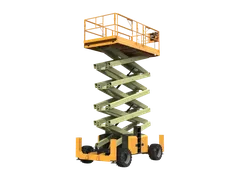
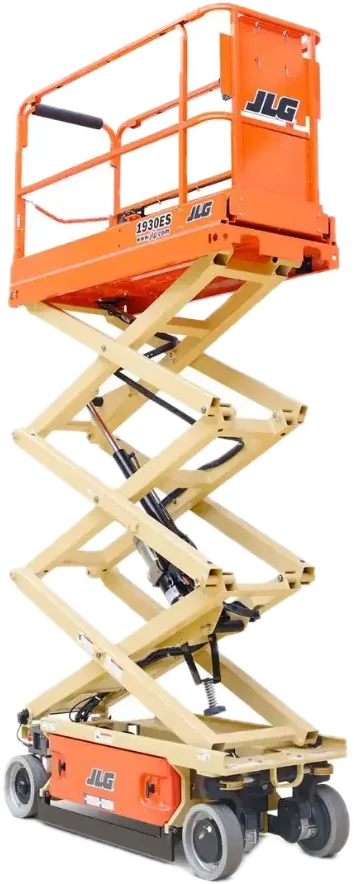
A scissor lift raises a platform straight up on crossing supports that fold and unfold. It moves up and down. Apart from a short slide-out deck on some models, it cannot move the platform sideways.
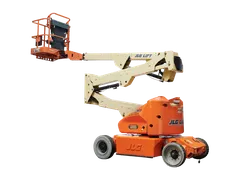
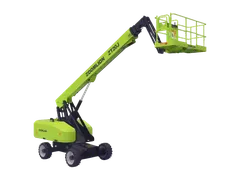
A man lift is the everyday name for a boom lift, also called a cherry picker. It carries a small basket on a boom. The boom can move up and out, so the basket can reach a point that is not above the machine.
Outreach is the one difference that drives the decision. Some people use "man lift" for any platform that carries people, scissor lifts included, so write "scissor" or "boom" in the request.
Is your work point directly above a place the machine can stand?
Apply this rule first. Stand at the spot you need to reach and look straight down to the floor or ground. If the machine can stand there, with enough clear space and firm ground, a scissor lift can do the job. If something blocks that spot, you need outreach, and that means a boom lift.
Typical scissor lift jobs are lighting, ducts and cable trays in a warehouse, where the work is right above usable floor. Often the floor below is not usable. For example:
- Racking, pallet stacks or a production line sit under the work point.
- A pit, trench, ramp or open edge is below the work.
- You need to reach past a parapet or over a roof edge to a wall or sign.
A scissor lift cannot solve any of these, however tall it is, because it would need to stand under the work. A boom lift stands on clear ground to one side and moves the basket across. The common mistake is ordering a scissor lift because the height matches. The fix is to write what is below the work point in the request.
Note. "Can stand" means more than empty space. Check the floor strength, edges, openings and slope against the machine's manual and the site rules. Outdoors, the manual also sets the wind limit: if it is reached, the work stops.
The machine also needs room to get there. Ask the supplier for its stowed height, width and weight, and compare them with doors, ramps and anything overhead. Leave clear space above the platform too: pipes, beams and ceilings can trap or crush a person at the controls.
Watch out. Before any lift moves or works, look for overhead power lines along the route and at the work point. Ask the site owner or the supplier what clearance applies, and have the site owner confirm it in writing where the site requires it. Do not guess.
Articulating boom or telescopic boom: what does each do best?
| Question | Articulating (knuckle) boom | Telescopic (straight) boom |
|---|---|---|
| How it moves | Has joints, so it can bend up and over | Extends in a straight line, raised at an angle |
| Best at | Reaching up and over tall obstacles, working around structures | Long horizontal outreach, reaching a distant point |
| Watch out for | Horizontal outreach is usually shorter than a telescopic boom of similar height: check the specification | Can reach over low obstacles in its path, but cannot bend up and over a tall one or reach down behind it |
Ask for an articulating boom when the work point is behind or above something tall and the basket must go up, over and then in or down. If the path is clear or the obstacle is low, a telescopic boom usually gives the longest horizontal outreach. Either way, ask the supplier for working height and outreach from the specification, and give the height and position of the obstacle in your request.
How do platform size, load capacity and number of workers compare?
A scissor lift platform is generally larger than a boom basket. It carries more people and material, so it suits long ceiling or overhead runs where several people and tools work together.
A boom basket is small. Its rated load covers people, tools and materials together, so a heavy toolbox takes capacity from the people. Workers in a boom basket normally wear a harness attached to the basket anchor point, following the manufacturer's manual and the site rules. On a scissor lift, harness rules depend on the manual, the site rules and the risk assessment, so ask.
Three rules apply to both machines:
- The rated platform load and the maximum number of people are marked on the machine. Do not exceed them.
- Neither is a crane or a loading platform. Do not use them to lift loads that are not part of the rated platform load. Never stand on the guardrails, or add a ladder or planks, to gain height.
- Whoever runs the machine should be trained and authorised for that type of lift. Ask the supplier what operator training or certificate they can show, and ask the site owner what proof the site requires. Agree who will bring the platform down if the operator is unwell or the controls fail.
Working height is not platform height: a worker can usually reach somewhat higher than the platform floor, so check which figure the supplier quotes. To size a scissor lift by height and power, see how to choose a scissor lift.
What about ground, doors, floors and tight access: when does a spider lift make sense?
Sometimes the problem is getting in, not reach. A spider lift is a compact tracked boom lift. Many models pass through narrow openings, work on delicate floors with the right track pads, and level on uneven ground within the manual's limits. Think of one when:
- The only way in is a standard door, a corridor or a small gate.
- The floor is finished or delicate, such as a lobby, a showroom or a hotel. Ask about track pads and floor protection.
- The ground is uneven. Soft ground still needs checking against the manual, because the legs press on it.
Expect a small basket: for several people on a big ceiling, a scissor lift on a clear floor usually fits better. The site owner or building manager can confirm floor loading.
A quick comparison table to decide in one minute
| Question | Scissor lift | Boom lift (man lift) | Spider lift |
|---|---|---|---|
| Is the work point above usable floor space? | Yes, ideal | Works, but may be more than you need | Works, if access is tight |
| Must you reach over or around something? | No, it cannot | Yes, this is its job | Yes, within its reach |
| Platform size | Larger, more people and tools | Small basket | Small basket |
| Narrow doors or delicate floors | Depends on the model: check width, weight and floor loading | Often larger and heavier: check the specification | Designed for this |
Write four things down before you order: the work height, what is below the work point, the route in and the floor or ground the machine will stand on. For the checks before the machine is used, see scissor and boom lift pre-use checks and operating limits. For other ways to work at height, such as scaffolds, see work at height equipment compared.
How to do this on Maedah
Post a request once, with your site notes in it. Pick the category that fits: scissor lifts, man lifts or spider lifts. Add the site on the map, the dates and any requirements, such as an operator, and describe what is below the work.
Suppliers who offer that category and serve your city send sealed quotes. Compare them side by side: what is included, whether an operator is part of it, response time and rating. Ask the supplier for the current inspection certificate and the operator's training proof. Then agree the details with your chosen supplier.