Quotes come back with names like tractor head, lowbed, tipper and water tanker, and a wrong guess means the wrong vehicle at the gate. This guide covers the types of trucks and trailers for construction and what each one does. Use it to describe your load, not only a vehicle name, before you ask for quotes.
What is the difference between a truck, a tractor head and a trailer?
A rigid truck carries its body on the same chassis as the cab and engine. Most dump trucks, box trucks and pickups are rigid vehicles, and so are many tankers.
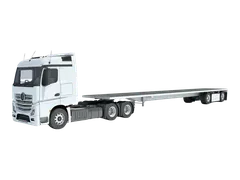
A tractor head (also called a prime mover) has no load bed of its own. It pulls a semi-trailer through a coupling. Because the trailer is separate, one head can work with different trailers on different days.
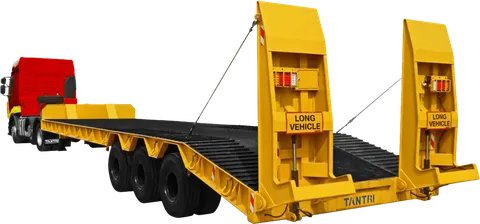
Lowbeds and flatbed trailers are usually towed units behind a tractor head. When you hire one, you often need both, so confirm that the supplier provides the head and the driver as well.
Tip. If a quote says "lowbed" or "trailer" only, ask whether the tractor head and driver are included.
Which vehicle carries heavy machines?
Excavators, loaders, rollers and generators usually travel on a trailer. Three types do most of this work:
- Flatbed: a flat deck at normal height. Good for pallets, pipes, steel and machines that are not tall. Containers need a deck fitted to hold them.
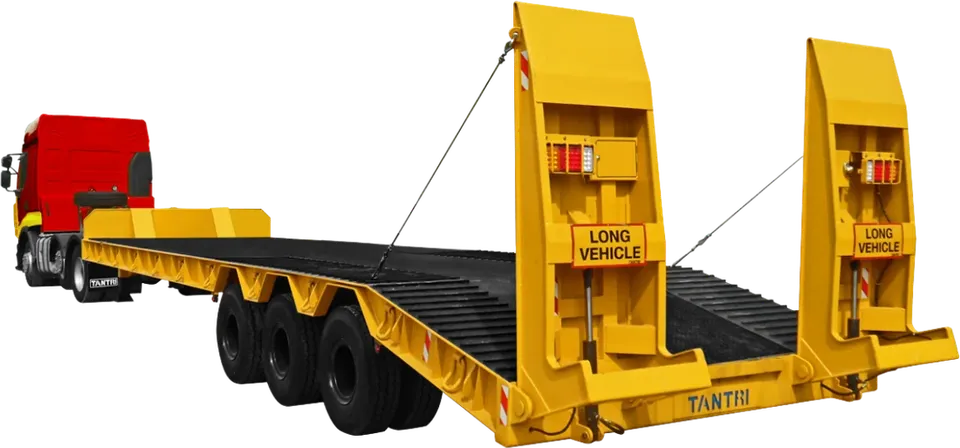
- Lowbed: a deck that is lowered, so a tall machine stays within a lower overall height. Good for tracked or tall machines such as excavators and dozers.
- Modular trailer: built from axle modules coupled together. Used for very heavy or very long loads.
The deck type is only the start. The real choice depends on the machine's weight, width, height and length, plus the route. Also say how the machine will get on: driven up ramps or lifted by a crane, and who provides them. The machine must be loaded, chained and secured as the supplier and the machine's maker instruct. For the full comparison, read lowbed vs flatbed vs modular trailer. For the checks before the trip, use the pre-trip checklist for moving a heavy machine by lowbed.
You can browse flatbeds, trailers and tractor heads as separate categories.
Which vehicles move sand, aggregate and excavated soil?
Bulk material such as sand, gravel, crushed stone and excavated soil (also called spoil) usually travels in a dump truck (tipper). Most bulk loads go in a rigid dump truck, which has an open body that tips. Some suppliers offer a tipping semi-trailer (tipper trailer) behind a tractor head for larger loads.
Say the material, the daily volume and the tipping place, and ask for the body size and payload. A dump truck unloads by tipping its body with a hydraulic ram. Tip only on level, firm ground, clear of overhead lines.
Some work needs a different vehicle, such as an articulated hauler for rough ground or a larger hauler for a quarry. That is a separate decision, covered in dump truck types: rigid, articulated and mining haulers.
Which vehicles carry water, fuel and sewage?
Liquids travel in tankers. A tanker can be a rigid truck with a tank on the chassis, or a tank on a semi-trailer behind a tractor head.
Tankers are not interchangeable between liquids. A tank that has carried fuel or sewage should not be used for drinking water, so say what the tank will carry when you order.
Common site uses:
- Water tanker: dust control, compaction, concrete curing and cleaning.
- Fuel tanker: fuel for machines and generators on remote sites. Fuel is dangerous goods, so ask the supplier what vehicle and driver requirements apply.
- Sewage tanker (vacuum truck): emptying septic tanks and temporary site facilities. Ask where the waste will be discharged and who approves that place. See how to book a vacuum truck or septic tanker.
For what to specify before booking, see water tanker hire for construction sites.
Which vehicles move materials, staff and small loads?
Not every job needs a heavy vehicle. Smaller rigid vehicles cover the daily site traffic:
- Pickup: a few people, tools and light loads.
- Box truck (closed body): goods that must stay dry, clean and locked, such as tools, cement bags or electrical items.
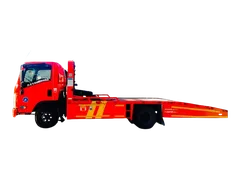
- Flatbed truck: a rigid truck with a flat deck, for bricks, blocks, pipes and timber that are loaded from the side or rear. (The flatbed trailer above is the towed version.)
- Crew bus or van: moving workers between camp and site.
Think of these first for supply runs. A trailer and tractor head for a few pallets is usually more vehicle than the job needs.
Watch out. People ride in seats, never on the load bed of a pickup, flatbed or dump truck. Transporting workers has its own rules, and requirements differ by project, site owner, municipality and insurer, so confirm them before mobilising.
What decides how much a vehicle can carry?
The answer is payload. Payload is the vehicle's permitted gross weight minus its own empty weight.
The load, its fixings and anything extra you put on the vehicle all count towards the gross limit. Chains, straps, timber packing, tools and spare parts all count too. Ask the supplier what the stated empty weight includes (fuel, driver, spare wheel).
Axles also matter. More axles spread the same load over more tyres and axle lines, which lowers the weight on each axle. The permitted limits are set per vehicle and per road, so ask the supplier for the vehicle's rated figures instead of assuming them.
Give the machine's weight with its attachments fitted, such as the bucket or breaker. For example, say a machine weighs 20 tonnes with its bucket on, and the fixings and accessories add 1 tonne. The load is 21 tonnes. The vehicle's payload must be at least 21 tonnes. The weight on each axle must also stay within its limit, which is why you ask for the rated figures. This is an example of the method, not a recommendation for any vehicle.
Ask the supplier:
- What is the vehicle's permitted gross weight?
- What is its empty weight, and so its payload?
- How many axles does it have?
- Are the figures from the vehicle's own documents, and does the head's rating cover the trailer and load together?
- Is the route suitable for this vehicle's height, width and weight?
Which vehicle fits which job?
Use this as a starting point, then confirm the choice with the supplier.
| Job | Usual vehicle | Ask the supplier |
|---|---|---|
| Move an excavator or dozer | Lowbed behind a tractor head | Deck height, payload, head and driver |
| Move very heavy or very long loads | Modular trailer | Axle configuration, route checks |
| Move pipes, steel, pallets | Flatbed truck or flatbed trailer | Deck length, payload, tie-down points |
| Haul sand, gravel, excavated soil | Dump truck | Body size, payload, tipping area |
| Supply water for dust or curing | Water tanker | Tank capacity, pump |
| Carry fuel to machines | Fuel tanker | Suitability for fuel, dispensing method, vehicle and driver requirements |
| Empty a septic tank | Sewage tanker | Tank capacity, disposal point |
| Carry tools and dry goods | Box truck | Body size, locking |
| Move a few people and tools | Pickup or van | Seats, permitted use |
How to do this on Maedah
On Maedah, post a request with the machine or load, its weight and dimensions, the city and site on the map, the pickup and drop-off places, and the dates. Add requirements such as driver and insurance.
Suppliers who offer that category and serve your city send sealed quotes. Compare them side by side: what is included, the response time and the rating. Ask in chat that the quote covers the head, the trailer and the driver, and confirm payload before you accept. Price and payment are agreed with the supplier.