A wrong trailer shows up on the day: a machine too tall for the road, a deck rated too low, or no safe way to load. This guide is for contractors, site teams and owners moving an excavator, loader or roller. It covers lowbed vs flatbed trailer, when a modular trailer is needed, and what to send so the first quote is the real one.
How do you choose a trailer: weight, height and width?
Start with the machine, not the trailer. Three numbers decide almost everything.
Weight. Use the operating or shipping weight from the machine's plate or manual, or ask its supplier. If you find two figures, use the higher one. Include the attachment that is fitted, such as the bucket, breaker or counterweight. Do not use a rounded guess. The trailer's rated capacity must be above the machine's weight. The tractor head must also be rated to pull the trailer and the load together, and the loaded vehicle must stay within the weight limits for the route.
Height. Overall height on the road is the deck height plus the machine's height. A tall machine on a high deck can become too tall to travel. A lowbed has a lowered deck, and that is what keeps a tall machine within a lower travelling height. Even so, confirm the final loaded height with the transporter.
For example, say the machine is 3.5 m tall as it travels. On a flatbed with a 1.5 m deck, the loaded height is 5.0 m. On a lowbed with a 1.0 m deck, it is 4.5 m. These figures are only an example; ask for the real deck height of the trailer offered. The lowest bridge or cable on the route decides whether that difference matters.
Width and length. Compare the machine's width and length with the deck. A machine wider or longer than the deck, or than normal road limits, changes what you need.
Tip. Measure the machine as it will travel: boom folded, arm lowered, and anything the manual says to remove taken off.
When is a flatbed enough?
A flatbed is a plain, flat deck. It is a good choice for materials, pipes, steel and light machines.
Be careful with machines. A machine driven up onto a high deck sits higher, and so does its centre of gravity. That is a stability risk on bends, slopes and uneven ground.
Use a flatbed only when the machine is light for the trailer, low enough that deck plus machine height suits the route, and there is a safe way to load it. If any of these is in doubt, ask the transporter before you book. Do not decide on price alone.
When do you need a lowbed?
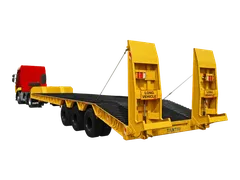
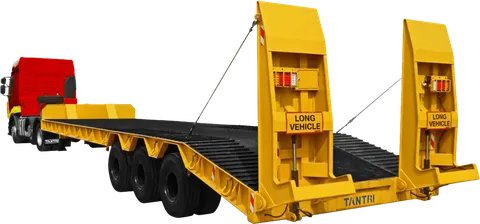
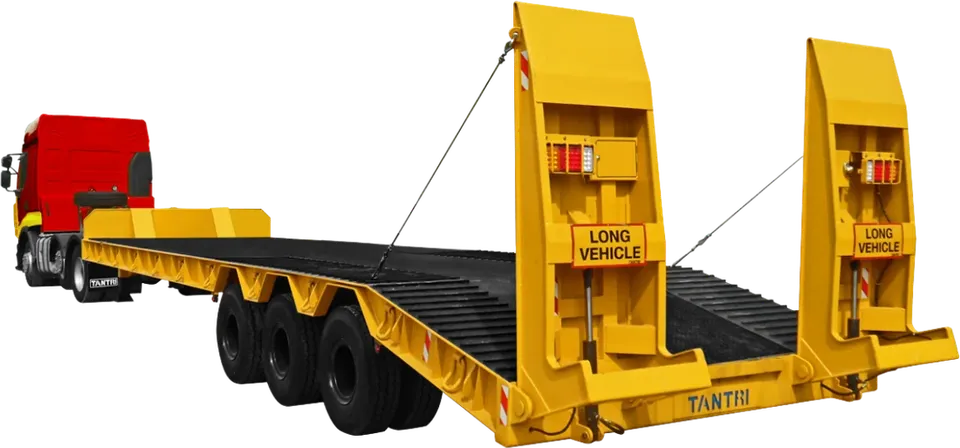
A lowbed has a deck that sits low, in a recess between the front section and the rear axles. The lower deck keeps the centre of gravity and the overall height down. That is why excavators, wheel loaders, dozers and other tall or heavy machines usually travel on lowbeds.
Choose a lowbed when:
- the machine is tall, so deck plus machine height may be too much on a flatbed;
- the machine is heavy and you want it carried low and steady.
A lowbed sits close to the ground. Tell the transporter about steep site entrances, kerbs and speed bumps so the trailer is not grounded. Availability differs by city and season, so ask early. For the full check before the trip, see moving a heavy machine by lowbed: pre-trip checklist.
When is a modular trailer the answer?
A modular trailer is built from axle lines and platforms coupled together. More axles share the load, so a very heavy or very long load is spread over more of the road surface. The transporter can set up the trailer to match the load.
Think of one when the load is very heavy or very long, such as a large transformer or a big crane component. For a long load, first ask whether the transporter has an extendable lowbed. If the biggest lowbed on offer is not enough, ask about a modular trailer.
This is a specialist job. It takes more planning, and the route usually needs a closer look, including bridges and clearances. Talk to the transporter early.
How does the machine get on and off the trailer?
People forget this question. A machine that cannot get on safely cannot travel.
Lowbeds are usually loaded in one of two ways:
- Rear ramps. The machine drives up ramps at the back of the trailer.
- A detachable gooseneck. On some lowbeds the front section is removed or lowered, so the machine can be driven straight on from the front.
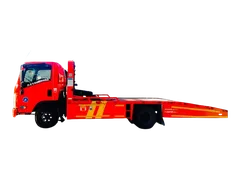
A flatbed has no built-in way to load a machine. It needs ramps, a dock or a crane, and any ramp or crane must be rated for the machine. Say which you have on site.
Any machine that is driven on, tracked or wheeled, needs ramps or a gooseneck that suit its weight. Check the ground at both ends: firm, level, with room for the trailer to line up. Ask who loads and who unloads.
Watch out. A machine on wet, soft or sloping ground can slip while loading. If the loading ground is poor, tell the transporter before the day.
Lowbed, flatbed and modular side by side
Two questions pick the trailer. Is the machine tall or heavy for the trailer you would otherwise use? Ask for a lowbed. Is the load much heavier or longer than the biggest lowbed the transporter offers? Ask about a modular trailer.
| Flatbed | Lowbed | Modular trailer | |
|---|---|---|---|
| Best for | Materials, pipes, steel, light machines | Tall or heavy machines | Very heavy or very long loads |
| Deck | High, flat | Low, often with a gooseneck | Built from axle lines and platforms |
| Overall height | Higher: deck plus machine | Lower: lowered deck keeps height down | Set up to suit the load |
| Loading | Ramps, dock or crane | Rear ramps or gooseneck | Planned for the load |
| Watch out for | Machine too tall or unstable on a high deck | Low ground clearance and loading room | Route check and early booking |
Capacity is not in the table on purpose. It varies by trailer, so ask for the rated capacity of the exact one.
What should you tell the transporter before they quote?
Send these details with the first message, so the quote is not corrected later:
- Machine: make and model.
- Weight: operating or shipping weight, with the attachment fitted.
- Dimensions: length, width and height as it will travel.
- Pick-up and drop-off: the city, the site, and any access limits such as gates, slopes or soft ground.
- Loading: whether there are ramps, a dock or a crane, and who loads.
- Timing: the day and any site time limits.
Then ask the transporter:
- What is the rated capacity of this trailer, and of the tractor head?
- What is the overall loaded height?
- Do I need escorts, permits or restricted movement times on this route?
- Who arranges them, and who is responsible if the plan changes?
- How will the machine be secured on the trailer, and with what? Ask whether it is chained to rated anchor points.
- What does the price include and leave out? See what an equipment rental rate includes and leaves out.
If the machine is coming from a port, read moving equipment from port to site. For a wider view of the vehicles, see construction trucks and trailers explained.
How to do this on Maedah
Post one request with the transport you need, the city and site on the map, and the date. Add the pick-up and drop-off details, and the machine's weight, dimensions and attachment, in the notes. Suppliers who offer that category and serve that city can answer with sealed quotes.
Compare the quotes side by side: what is included, who loads, who handles permits, and the response time. Agree price and payment with the supplier. Maedah does not process payments. For more, see how to compare equipment rental quotes fairly.