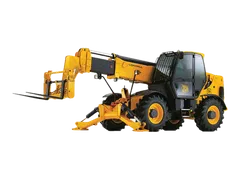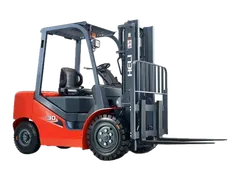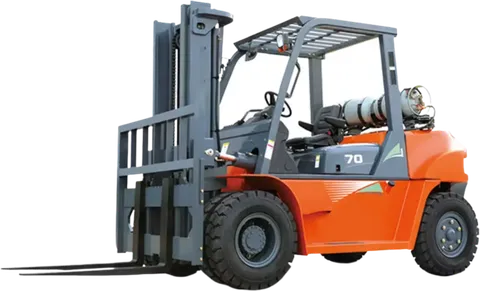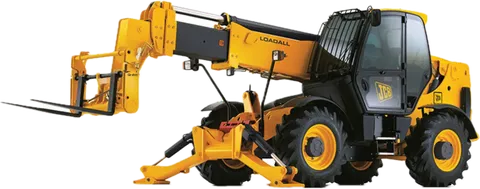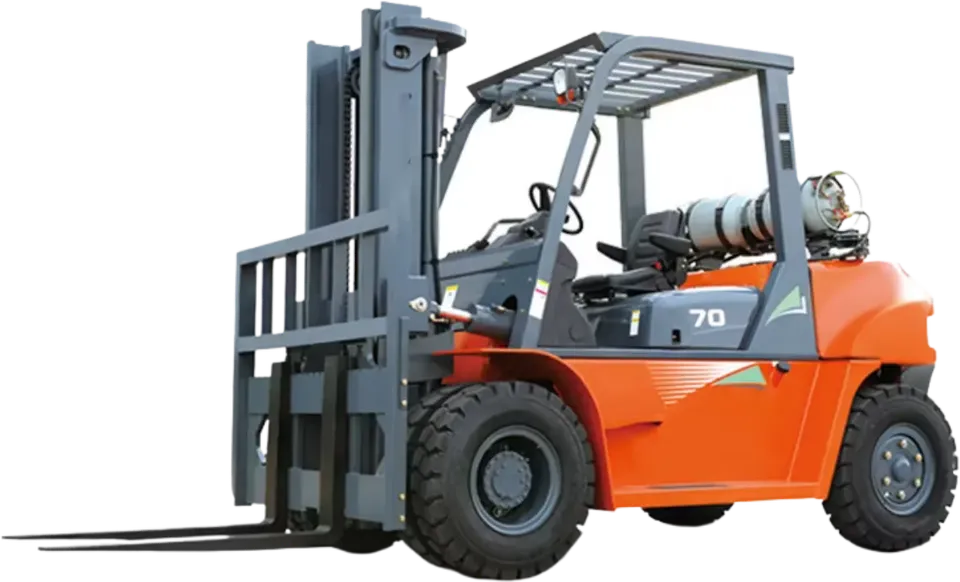
A forklift and a telehandler (a telescopic handler, with a boom that extends) both carry loads on forks, so they are easy to confuse. If you must move materials on a site, this guide helps you decide telehandler vs forklift with three checks before you call a supplier: where the load must go, what the ground is like, and what is in the way.
Telehandler vs forklift: what is the basic difference?
A forklift lifts on a vertical mast. The forks travel up and down the mast, so the machine must be driven close to the place where the load will be set down.
A telehandler lifts on a boom that extends forward and upward. That lets it place a load over an obstacle, across a gap or onto a raised deck, without driving up to the edge.
A forklift's lifting height is set by its mast, so for deck or roof heights ask the supplier for the machine's maximum working height and the load it carries there. A telehandler is usually larger and heavier than a forklift, so check gates, aisles and indoor space.
| Forklift | Telehandler | |
|---|---|---|
| Lifting arm | Vertical mast | Boom that extends forward and upward |
| Load placed | Directly in front of the machine | Out and up, over obstacles or gaps |
| Typical ground | Firm, smooth surfaces (or a rough-terrain type for outdoors) | Rough or unpaved ground |
| Size and space | Usually more compact, easier in narrow aisles | Larger and heavier, needs more room |
Which tasks need a telehandler, and which a forklift?
Match the machine to the task. This table shows the usual fit; your site layout can change it.
| Task | Usually better | Why |
|---|---|---|
| Moving pallets from a truck to a store area on firm ground | Forklift | Short, repeat moves; mast lifting is quick |
| Putting pallets into racking in a warehouse or yard | Forklift | Built for stacking straight up and down |
| Bricks or blocks to a first-floor deck or a scaffold level | Telehandler | Load must go up and forward onto the deck; confirm the deck or scaffold is rated for the load |
| Roof sheets or purlins to a roof edge | Telehandler | Reach over the wall or edge |
| Formwork or steel bundles over a trench or fence | Telehandler | Boom crosses the obstacle |
| Unloading a flatbed on uneven ground | Telehandler or rough-terrain forklift | Tyres and chassis suited to rough ground; very soft ground still needs a firm path |
If most of your day is repeat pallet work, the forklift usually wins on speed. If even a few lifts per day need reach, a telehandler may save a second machine.
Before you choose, measure the heaviest load, the highest point it must reach and how far out it must be set down. For example, a pallet set on a truck bed is a different job from the same pallet set on a deck that is 6 m up and 4 m back from the edge.
Why does a telehandler's capacity change with boom reach?
On a forklift, the load sits close to the mast. On a telehandler, it sits at the end of a long arm. The further the load is from the front wheels, the harder it tries to tip the machine forward.
So a telehandler's rated capacity falls as the load moves further out from the front wheels. Reaching higher usually needs more boom extension, so capacity at height is usually lower too. The load chart, usually shown in the cab, gives the capacity for each boom angle and extension. The maximum capacity usually applies only at short reach.
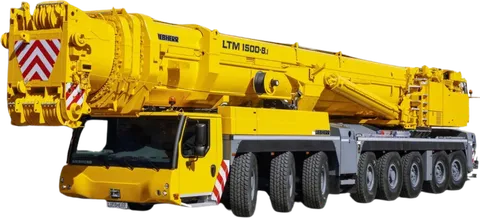
For example, say a telehandler can carry a pallet of blocks near its front wheels. The same pallet may be too heavy at the far end of the boom. Compare your load weight with the chart at the exact reach and height you need, not with the maximum capacity. A crane works the same way, as a crane load chart shows.
A forklift's rating also depends on the load centre, measured from the fork face to the load's centre of gravity. See forklift capacity and load centre explained.
Watch out. A load chart is valid only for the attachment and set-up it was written for, so check that it matches yours.
How do ground and access change the choice?
Ground is often the deciding factor. A standard warehouse forklift is meant for smooth, firm surfaces. On sand, loose gravel or mud it can sink or become unstable.
A telehandler normally has large pneumatic tyres and is made for rough or unpaved ground. A rough-terrain forklift is the forklift type made for outdoor uneven ground, so it is often a sensible middle option for pallet work outside. See types of forklifts and how to choose one for the main types.
Check these before you decide:
- What is the surface: concrete, compacted fill, sand, mud?
- Is the slope gentle, or are there ramps and trenches? Ask the supplier for the machine's slope limits.
- Is there a clear route and enough turning space for the machine and the load?
- Are there overhead power lines, cables, roofs or walls above the route or the lift? Keep the clearance your site, client or the utility sets, and ask the supplier for the machine's working height.
- Does the machine need to cross or stop on soft backfill or a slab edge?
Some telehandlers have stabilisers or outriggers that must be set when the manufacturer's load chart requires it. They need firm, stable support under each one, as the supplier directs. Ask the supplier to show how the machine is set up.
What attachments can each machine take, and what must be rated?
Both machines usually work with forks, and many take other attachments. Every attachment must be approved for that machine and match the load chart.
- Forks and pallet carriages: check they suit the pallet and the load length.
- Buckets, grabs and bale or block clamps: they change the load centre and the capacity, so the chart must cover them.
- Hook or jib: a telehandler is not a crane. Hanging a load from a hook or jib needs an attachment the manufacturer has approved for that machine, a matching load chart and proper rigging.
- Work platform: lifting people needs a platform and controls approved for that machine, and the supplier's and site's procedures.
Watch out. Never put a person on forks, a pallet or a bucket. If you need access to work at height, ask for an approved platform, or consider another machine.
Rules for work platforms and operator authorisation differ by project, site owner and insurer. Confirm them before mobilising.
If the job is mainly hook work, compare a boom truck and a mobile crane instead.
What should you check before the machine arrives?
Send the supplier these facts, then check what comes back.
- Load: the heaviest item, its size and what it is packed on.
- Placement: the greatest height and the farthest reach, measured on site.
- Ground: surface type, slope and the access route.
- Attachments: forks only, or anything else, and whether a platform is needed.
- Operator: is the operator included, and what proof of training and site authorisation can they show?
When the machine arrives, ask for:
- The load chart for this machine, and where it sits in the cab.
- The attachment list and the rated limits.
- A current inspection certificate and its expiry date.
- A walk-round showing tyres, forks, boom, hydraulics, warning devices and, where fitted, stabilisers.
Do not accept a machine whose chart is missing or does not match the attachment. Run the daily pre-start check before the first lift.
How to do this on Maedah
Put the machine type, quantity, city, site on the map, dates and any requirement such as a driver in one request on Maedah. Add the height, reach, load weight and ground in the details.
Suppliers who offer telehandlers or forklifts in your city can send sealed quotes. They appear side by side, so you can compare what is included, response time and rating. Chat about the load chart before you accept, and agree price and payment directly with the supplier.