If you must transport heavy equipment from port to site in Saudi Arabia, the ship is booked but the road leg may not be. This guide is for project and procurement managers with an imported machine, container or plant on the way. It follows the cargo in order, shows who usually owns each leg and lists what to settle before the cargo is released.
What are the steps from ship to site?
Each leg needs an owner and an answer to one question before the next leg can start.
| Leg | Who usually owns it | Question to settle early |
|---|---|---|
| Cargo details | Importer, with the seller | What exactly is landing, and how is it packed? |
| Clearance | Importer or clearing agent | Who handles it, and what do they need from you? |
| Port collection | Transporter or clearing agent | Who gets the cargo out of the port or yard? |
| Vehicle | Transporter | Which trailer fits the loaded size and weight? |
| Route and timing | Transporter | Which permits, escorts and windows apply? |
| Site receiving | Site team or contractor | Can the site take the vehicle and unload it? |
| Arrival check | You and the transporter | What is the condition on arrival? |
What do you need to know about the cargo before it lands?
Get the facts from the seller or shipping documents before the ship arrives. You need these for the transporter:
- Weight, and length, width and height as packed.
- How it ships: container, flat-rack, open-top or breakbulk.
- Number of pieces, if it is dismantled.
- Marked lifting and lashing points, and the centre of gravity. The unloading plan depends on them.
A load that does not fit a standard closed container is called out-of-gauge. It can travel on an open-top container, on a flat-rack container or as breakbulk cargo. In every case it is secured, usually lashed, to its base or frame.
Large machines are sometimes shipped partly dismantled. Booms, counterweights or attachments may be removed to fit transport limits. If so, plan the reassembly: who does it, where, and which equipment is needed to lift the parts back on.
Watch out. A packed size is not the machine's catalogue size. Use the dimensions and weight of the cargo as it will actually sit on the trailer.
Who clears the cargo, and who collects it?
Customs clearance is arranged by the importer or by a clearing agent. This guide does not explain customs rules. Ask your agent or the authority what applies to your shipment.
What you control is the handover. Agree in writing who handles four things:
- Clearance.
- Collection from the port.
- The trailer for the road leg.
- Unloading at the site.
The common mistake is a gap between two parties, each assuming the other has the next step. The fix is a one-page message: for each of the four items, one company, one person's phone number and one date.
Cargo left at the port, or a container not returned on time, can attract storage or detention charges. Line up the vehicle before the cargo is released, not after.
Which vehicle moves your cargo?
Match the vehicle to the cargo type.
| Cargo | Typical vehicle | Watch out for |
|---|---|---|
| Standard container | Container-carrying trailer behind a tractor head | The container, or its contents, still needs a planned way off at the site |
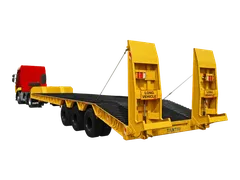
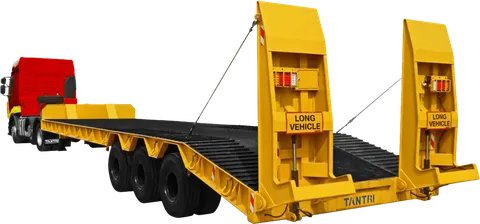
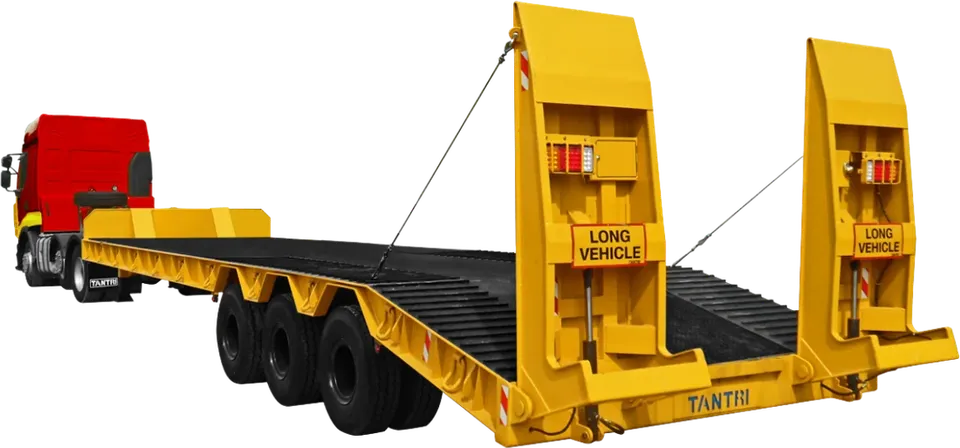
| Out-of-gauge machine, moderate weight | Often a lowbed | Loaded height, width and axle loads |
| Very heavy or very long machine | Often a modular trailer | Availability, route restrictions and permits |
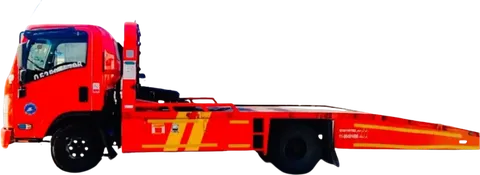
| Dismantled parts | Flatbed or lowbed, sometimes several trucks | Each part has its own weight and size |
The lowbed deck is low so that tall machines have a better chance of staying under road height limits. Even so, the transporter must check the loaded height against the actual route. If you are unsure between types, read lowbed vs flatbed vs modular trailer.
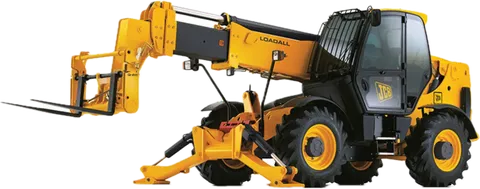
Containers are lifted at the port or yard by machines such as reach stackers and cranes. Ask who provides the lifting machine at the yard, and whether it is included in the transporter's offer.
How do you plan the route and timing?
Movement windows, escorts and permits for oversize loads differ by city, route and authority. Do not assume that a route used for a standard truck works for yours.
Ask the transporter:
- Which permits does this load need, and who applies for them?
- Is an escort required, and who arranges it?
- Which hours is the route open to this load?
- Are there low bridges, narrow roads or turns on the route that the loaded height or width cannot pass?
- What happens if the permit is late: where does the load wait?
Confirm the answers before the cargo is released. Then match the arrival time to the site's working hours and the summer heat, so that unloading does not start in a rush.
Port cities add their own points. See planning equipment for a Jeddah site or equipment planning in Dammam and the Eastern Province.
Is your site ready to receive and unload it?
A site that is not ready makes a truck wait, which can be costly and can block the access road.
Check before the day:
- The gate and the access road allow the length, width and turning of the loaded vehicle.
- The ground at the unloading point is firm and level enough for the loaded weight, and for any crane that will lift it. Ask your engineer to confirm if in doubt.
- There is a clear, marked place to unload, away from traffic and people.
- The unloading method is decided with the transporter and the machine's supplier: driving off the trailer or lifting off with a crane. Each needs a different crew and equipment.
- If a crane lifts the load, there is a written lift plan, a crane with current inspection records, and a competent operator and rigger. Use the manufacturer's load chart and the cargo's marked lifting points only.
- If the machine arrives dismantled, the assembly area and the lifting equipment are booked.
- A named person on site can sign for the cargo and speak to the driver.
For the loading and lashing checks on the vehicle itself, use the lowbed pre-trip checklist.
Tip. Share the site entrance, a pin on the map and a contact number with the driver in advance. Wrong turns can cost an oversize load a lot of time.
What should you check and photograph on arrival?
Photograph the cargo at the port, before it is moved, where access allows; otherwise ask your agent for the condition report. Then photograph it again at the site, before any lashing is released. Together the two sets show whether any damage happened on the road.
At the site:
- Compare the cargo with the packing list and the seller's description.
- Look at the lashings and supports. Photograph anything loose or broken.
- Check visible damage: paint, glass, hoses, lights, tyres or tracks.
- Write down any problem on the delivery note before you sign it and before the driver leaves.
- Unload only with the planned method and the planned crew, and do not release lashings until the unloading team is ready.
If you see damage, report it to the transporter and, if the cargo is insured, to the insurer. Check your own policy and contract for what is required and by when.
How to do this on Maedah
On Maedah you can post a request once instead of calling transporters one by one. Open the request form and choose the vehicle category, such as lowbeds or tractor heads. Set the city, the site on the map and the dates. In the notes, paste the cargo facts from the list above, the port or yard for pickup, and any needs such as a driver or insurance.
Quotes from suppliers come back sealed and line up side by side. Compare what each one includes: escort, permits, lifting at the yard, unloading. Then agree price and payment with the supplier you choose. Maedah does not process payments.