A night shift is booked, but nobody has yet said how many lights to order or where they stand. This guide is for supervisors, road-works and event planners who need to settle that before calling a supplier. It turns a site plan into a clear order for tower lights for night work, and gives a first-night check.
Why use tower lights for night work and not ordinary floodlights?
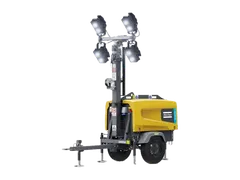
A mobile tower light is a trailer with a telescopic mast that carries a group of lamps. Many have a built-in diesel generator, so the whole unit arrives, is towed into position and works without a site connection. Some models take a grid connection or use hybrid power, so say which one you want.
Floodlights on a stand suit a small fixed area with power already available. A raised mast suits moving work and large areas: it puts the light above the work, which cuts shadows and glare at eye level.
In Saudi summer, some outdoor work is moved to the evening and night to avoid the heat. That makes lighting part of the heat plan, not an extra. See planning equipment around Ramadan and summer schedules. Working-hours rules differ by project, site owner and municipality, so confirm yours first.
How many tower lights does my work area need?
Start with a plan of the site, not a number of towers. Mark three things on it:
- Work zones: where people and machines actually work tonight, not the whole site.
- Danger spots: excavation edges, haul routes, crane lifting areas, crossing points, stockpiles, anywhere machines and people meet.
- Access and exits: the paths people walk in, out and to welfare facilities.
Light is measured in lux, and the level needed differs by type of work and by the client's or authority's requirements. Ask the site owner or client for the target, give it to the supplier, and ask how many towers, with which lamp set, they recommend.
A common mistake is to count towers by area alone. A small area with trenches, a crane and a haul road may need more light points than a larger, open, flat one. Count the danger spots.
For example, picture a rectangular work zone with a haul road along one side and a crane lifting area at one end. You would want light on the lifting area and on the haul road from two sides each, so one tower per corner of that end is a better starting point than one tower in the middle.
Where do I put tower lights to avoid shadows and glare?
Place towers so that each important area is lit from at least two directions. One light from one side leaves a dark shadow behind every machine, stack and person, and that shadow is where accidents happen.
Use this layout method:
- Stand each tower outside the machine travel path, on firm, level ground, with room for the stabilisers.
- Put towers on opposite or adjacent sides of the zone, so each one lights the shadows the other leaves.
- Overlap the lit areas a little so there is no dark gap.
- Aim the lamps down into the work zone, not level.
- Walk the site after dark with the lights on, before the shift starts. Check from the machine cabs and from the road, and move or re-aim any lamp that dazzles.
Glare is a safety problem too. Badly aimed lamps can dazzle machine operators, passing drivers and neighbours. Beside live traffic, check the aim from the driver's side before work starts, and confirm any lighting requirements of the road owner or client.
Watch out. Keep towers and their cables out of machine paths. If a tower must stand near moving machines, mark it and agree an exclusion zone; see banksman and exclusion zones.
LED or metal halide lamps: what changes?
The lamp type changes how you operate the tower, so the supplier should state which one you are getting.
| LED | Metal halide | |
|---|---|---|
| Start | Immediate | Warm-up first |
| Restart | Immediate | Cool-down first |
| Power use | Lower | Higher |
| What to plan | Nothing extra | Keep on all shift; allow for warm-up and cool-down |
Power use is compared for the same amount of light. If the lights will be switched off and on during the shift, LED is simpler to live with. With metal halide, ask the supplier how long the warm-up and cool-down take, and keep the lamps on for the whole shift. A short power cut then means a dark zone while they restart, so work should stop there until the light is back.
What powers a tower light and how long will it run?
Many tower lights run on a built-in diesel generator; others use the grid or hybrid power. If your site has no reliable supply, a self-powered unit is usually the practical choice.
Runtime is set by the fuel tank and the load of the lamps. A bigger lamp set uses more fuel from the same tank. So ask for the stated runtime per tank for the lamp set you are offered, not a general figure.
Then plan refuelling:
- Count the hours you need light each night, including set-up and shut-down.
- Decide who refuels and when. Store fuel away from ignition sources, with spill control.
- Refuel at a planned time, with the engine switched off and cooled as the manual requires. Never refuel a running or hot engine.
The same planning applies to any generator; see generator fuel planning: runtime, tanks and refuelling. If the lamps run from a separate generator, that is a sizing job; see how to size a generator.
How do I set up and raise a light tower safely?
Set up in daylight if you can. Follow the manufacturer's instructions and the site rules; these are the common steps. Only trained people should raise the tower.
- Check overhead lines and obstructions. Look up before you tow or raise, and tow with the mast fully lowered and locked. Keep well clear of overhead power lines. The safe clearance distance is set by the site owner or the utility, so ask them; do not judge it by eye.
- Choose firm, level ground. Soft sand, fill or a slope can let a tower tilt.
- Secure the trailer and deploy the stabilisers fully, on firm footing, before you raise anything. Apply the brake and follow the manual for levelling, chocking and earthing.
- Check lamps, cables and fuel before the mast goes up.
- Raise the mast slowly, with people clear of it.
- Aim the lamps as the manual describes. Never climb the tower or reach under a raised mast to adjust them.
- Lower the mast in strong wind, and before storms or dust storms. The manufacturer states the maximum wind speed for a raised mast. Ask the supplier for it and agree who watches the weather and lowers the tower.
Watch out. Never move a tower with the mast raised.
On the first night, check these before work starts: every danger spot is lit from two sides, no lamp dazzles a cab or the road, cables are out of machine paths, and the fuel plan is written down with a named person.
What should I ask the supplier before booking?
- Which lamp type: LED or metal halide?
- Which power: built-in diesel, grid or hybrid?
- What is the stated runtime per tank for this lamp set?
- How many lamps, and how high does the mast go?
- What is the maximum wind speed for a raised mast?
- Is there an operating manual and a recent inspection record?
- Who delivers, sets up and refuels, and who do I call at night if a light fails?
If you also need power for tools, see how to rent a generator for a site. For the wider checklist, see setting up a site before mobilising.
How to do this on Maedah
Post one request in the Tower Lights category. Add the city, the site on the map and your dates and shifts. In the request description, write the work zones, the number of towers you expect, the lamp type and the power source. If you also need a generator, add it to the same request.
Suppliers answer with sealed quotes, shown side by side. Compare what is included, the lamp type and the stated runtime, then agree the terms with the supplier.